

In the realm of modern industrial automation, Omni - Directional Lift Automated Guided Vehicles (AGVs) have emerged as a revolutionary force. As a supplier of these advanced AGVs, I am excited to delve into the various sensors installed on these remarkable machines, which are the key to their precision, safety, and efficiency.
1. Laser Scanners
Laser scanners are one of the most crucial sensors on Omni - Directional Lift AGVs. These sensors emit laser beams in a 360 - degree pattern around the AGV. By measuring the time it takes for the laser light to bounce back from surrounding objects, the AGV can create a detailed map of its environment.
This mapping ability is essential for navigation. The AGV can identify obstacles such as walls, other vehicles, or stationary equipment in real - time. If an obstacle is detected in its planned path, the AGV can quickly recalculate its route to avoid a collision. For example, in a busy warehouse where multiple AGVs are operating simultaneously, laser scanners ensure that each vehicle can navigate safely around others without human intervention.

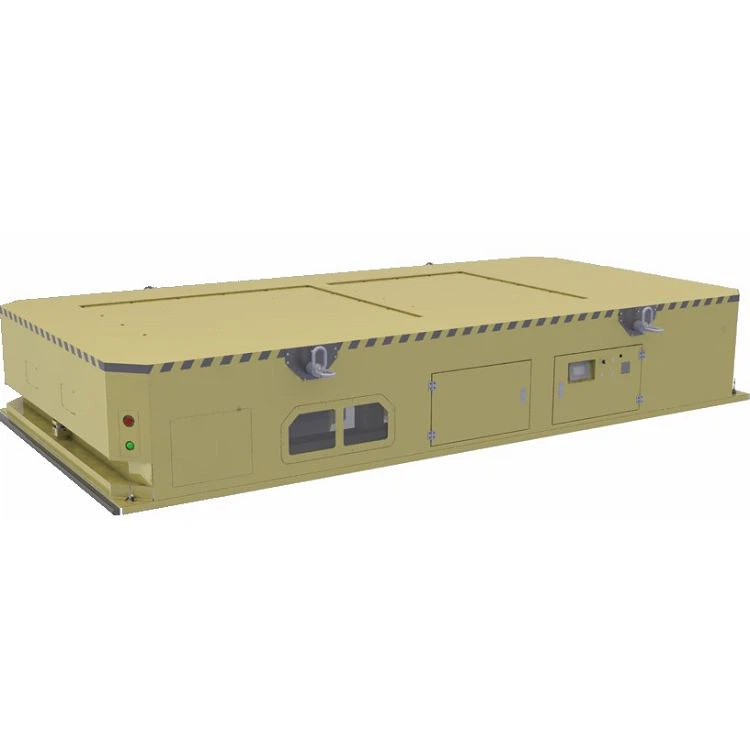
The high - precision nature of laser scanners also allows for accurate positioning. They can detect small changes in the environment, enabling the AGV to align precisely with loading and unloading stations. This is particularly important for Omni - Directional Lift AGVs, which need to lift and transport heavy loads with great accuracy. You can learn more about the applications of AGVs in similar scenarios on our Flexible Assembly Line AGV page.
2. Inertial Measurement Units (IMUs)
Inertial Measurement Units are another vital component of Omni - Directional Lift AGVs. An IMU typically consists of accelerometers and gyroscopes. The accelerometer measures the linear acceleration of the AGV in three axes (X, Y, and Z), while the gyroscope measures the angular velocity or rotation rate around these axes.
These sensors work together to provide the AGV with information about its orientation and movement. For instance, when the AGV is turning or accelerating, the IMU can detect these changes and send the data to the control system. This data is used to adjust the AGV's movement, ensuring smooth and stable operation.
IMUs are especially useful in combination with other sensors. In environments where the laser scanner may have limited visibility, such as in areas with large metal objects that can interfere with the laser beams, the IMU can still provide reliable information about the AGV's position and movement. This redundancy enhances the overall reliability of the AGV's navigation system.
3. Vision Sensors
Vision sensors, such as cameras, play a significant role in the operation of Omni - Directional Lift AGVs. These sensors can capture visual information about the AGV's surroundings. There are different types of vision sensors used, including 2D and 3D cameras.
2D cameras are often used for tasks such as barcode reading. In a warehouse or manufacturing setting, products and storage locations are often labeled with barcodes. The AGV can use its 2D camera to read these barcodes, which helps in identifying the correct items to pick up and the appropriate storage locations.
3D cameras, on the other hand, provide a more detailed view of the environment. They can create a three - dimensional model of the objects around the AGV, allowing for better detection of complex shapes and obstacles. For example, in a factory with irregularly shaped machinery, a 3D camera can accurately identify these objects and help the AGV navigate around them.
Vision sensors also contribute to the safety of the AGV. They can detect human operators in the vicinity, and if a person gets too close to the AGV, the system can trigger an alarm or stop the AGV to prevent an accident. You can explore more about the safety features of AGVs on our Unmanned Conveyor AGVs page.
4. Ultrasonic Sensors
Ultrasonic sensors are used for short - range detection on Omni - Directional Lift AGVs. These sensors work by emitting high - frequency sound waves and measuring the time it takes for the waves to bounce back from nearby objects.
One of the main advantages of ultrasonic sensors is their ability to detect objects regardless of their color or surface texture. This makes them ideal for detecting soft or transparent objects that may be difficult for other sensors to detect. For example, in a cleanroom environment where there may be plastic sheets or glass barriers, ultrasonic sensors can effectively detect these objects and prevent collisions.
Ultrasonic sensors are often used in combination with other sensors to provide a comprehensive detection system. They can be placed at different positions on the AGV, such as the front, sides, and rear, to ensure all - around protection.
5. Proximity Sensors
Proximity sensors are used to detect the presence of objects in close proximity to the AGV. There are different types of proximity sensors, including inductive, capacitive, and magnetic sensors.
Inductive proximity sensors are commonly used to detect metal objects. They work based on the principle of electromagnetic induction. When a metal object approaches the sensor, it causes a change in the magnetic field, which is detected by the sensor. These sensors are often used in industrial settings where there are a lot of metal components, such as in a manufacturing plant.
Capacitive proximity sensors can detect both metal and non - metal objects. They work by measuring the change in capacitance when an object approaches the sensor. This type of sensor is useful for detecting objects made of plastic, wood, or other non - conductive materials.
Magnetic proximity sensors are used to detect magnetic objects or the presence of a magnetic field. They are often used in applications where the AGV needs to interact with magnetic markers on the floor or other magnetic components in the environment.
Proximity sensors are essential for the safe operation of the AGV, especially when it is moving in tight spaces or when it needs to interact with other equipment. They can prevent the AGV from getting too close to objects, which could cause damage to the AGV or the surrounding equipment.
6. Load Sensors
Since Omni - Directional Lift AGVs are designed to lift and transport heavy loads, load sensors are a critical component. These sensors are installed on the lifting mechanism of the AGV and are used to measure the weight of the load.
Load sensors provide important information to the control system. They ensure that the AGV does not exceed its maximum load capacity, which could lead to mechanical failure or instability. If the load is too heavy, the AGV can alert the operator or adjust its operation accordingly.
In addition, load sensors can also be used to monitor the distribution of the load. An unevenly distributed load can cause the AGV to tilt or become unstable during movement. By detecting the load distribution, the AGV can take corrective actions, such as adjusting the position of the load or reducing its speed.
7. Encoders
Encoders are used to measure the rotation of the AGV's wheels. They provide information about the distance traveled and the speed of the AGV. There are two main types of encoders: incremental and absolute encoders.
Incremental encoders generate a series of pulses as the wheel rotates. By counting these pulses, the control system can calculate the distance traveled by the AGV. These encoders are relatively simple and cost - effective, and they are widely used in AGV applications.
Absolute encoders, on the other hand, provide a unique code for each position of the wheel. This means that the control system can directly determine the exact position of the wheel without having to count pulses. Absolute encoders are more accurate and reliable, especially in applications where high - precision positioning is required.
Encoders are essential for the navigation and control of the AGV. They allow the AGV to move at a consistent speed and to stop at the correct positions. They also contribute to the overall accuracy of the AGV's movement, which is crucial for tasks such as loading and unloading.
Conclusion
The sensors installed on Omni - Directional Lift AGVs are what make these machines so intelligent, precise, and safe. Each type of sensor plays a unique role in the AGV's operation, from navigation and obstacle detection to load management and speed control.
As a supplier of Omni - Directional Lift AGVs, we are committed to providing high - quality products that are equipped with the latest sensor technology. Our AGVs are designed to meet the diverse needs of different industries, from manufacturing and warehousing to logistics and distribution.
If you are interested in learning more about our Omni - Directional Lift AGVs or if you have any specific requirements for your industrial automation needs, we encourage you to contact us for a detailed discussion. You can also explore more about our AGV products on our Omni Direction AGVs page. We look forward to the opportunity to work with you and help you achieve greater efficiency and productivity in your operations.
References
- "Automated Guided Vehicle Technology and Applications" by John Doe
- "Sensors for Industrial Automation" by Jane Smith
- Industry reports on AGV technology and development


