


Omni Direction AGVs
Tianjin Lonyu Robot : Your Trustworthy Backpack Lifting AGVs Supplier!
Our company is a heavy-duty AGV company with the business philosophy of focus, professionalism, pragmatism and development. Langyu has been committed to professional R&D and production in the field of heavy-duty AGV and smart factory smart logistics. We have more than 50 patents (9 invention patents) and specialize in providing customers with heavy-duty intelligent logistics management systems supported by intelligent logistics technology, industrial Internet of Things, big data center and other technologies to solve the problem of intelligent transportation materials for large goods.
Products Widely Used
The products produced by our company can be widely used in the production, assembly, transportation and production of large workpieces (over-length, over-weight) in aviation, aerospace, military industry, high-speed rail, wind power, metallurgy, engineering machinery, ships, ports, airports, heavy industry and other industries. store.
Innovating
Our company has more than 50 patents, including 9 invention patents. Secondly, we have 131 independent core patents. And most of the products have passed CE, REACH, SGS, FCC and other certifications.
Customizable
Our team has 15 years of professional R&D and production experience in the field of smart logistics and can meet the needs of different markets and customers.
Wide Range of Cooperative Merchants
Since its establishment, our company has cooperated with well-known companies around the world, such as Tesla, Siemens, FAW Toyota, Jinfeng Technology, CAT, JLG and other well-known companies.
Related product introduction

Omni Directional Automated Guided Vehicles (AGVs) are robotic vehicles that can move in any direction and rotate on their own axis. These AGVs are equipped with multi-directional wheels or rollers that allow them to move sideways, diagonally, or in circular paths, as well as forward and backward. This makes them highly versatile and suitable for applications in manufacturing, warehousing, and logistics, where they can move materials and products with precision and efficiency. Omni-directional AGVs often use advanced navigation systems such as laser sensors, vision systems, and magnetic guidance to navigate complex environments and avoid collisions with obstacles.

All Direction Heavy Load AGVs refer to a type of Automated Guided Vehicle (AGV) that is designed to carry heavy loads in any direction. These AGVs are equipped with omnidirectional wheels that allow them to move in any direction, including sideways, diagonally, or even rotating around a central point. They are commonly used in factories, warehouses, and other industrial settings to transport heavy loads such as metal sheets, large machinery, or palletized goods. All Direction Heavy Load AGVs offer high flexibility and can navigate through tight spaces and crowded areas without requiring any human assistance.

Omni-Directional Lift AGVs are a type of Automated Guided Vehicles (AGVs) that are capable of moving in any direction and can also lift and transport materials and products. These AGVs use a combination of robotics, sensors, and software to navigate and communicate with their surroundings, allowing them to follow pre-programmed routes or adapt to changing environments. The lift feature allows them to pick up and transport heavy materials, saving time and reducing the risk of injury to human workers. These AGVs are commonly used in manufacturing facilities, warehouses, and distribution centers to improve productivity and efficiency.
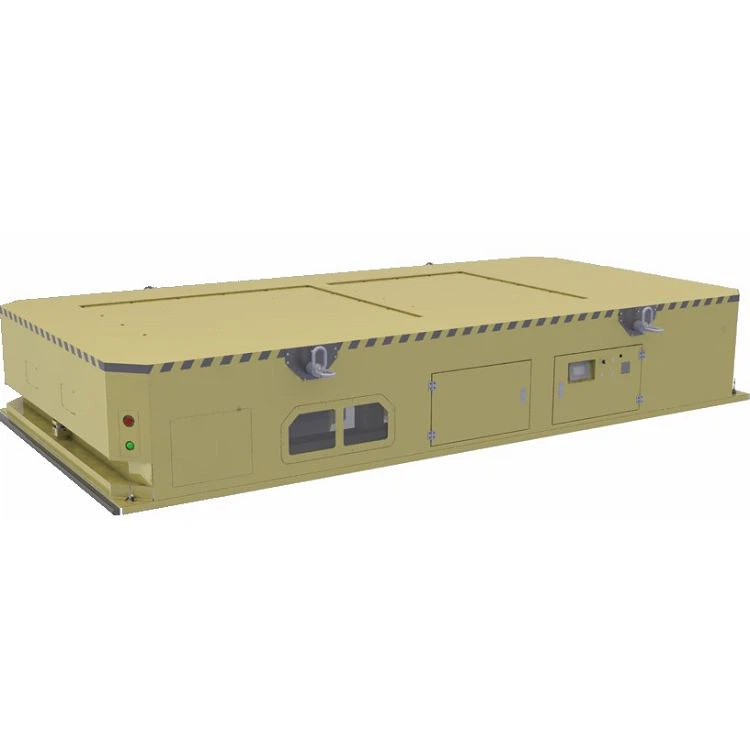
Unmanned Conveyor Automated Guided Vehicles (AGVs) are driverless, automated vehicles used for material transportation in manufacturing, warehouse and logistics industries. They are equipped with sensors, cameras and navigation technology that allows them to move autonomously from a starting point to a destination point without needing a human operator. They are typically used in environments where repetitive and low-skilled tasks are performed, such as moving raw materials or finished products from one location to another. Conveyor AGVs are specifically designed to move along a conveyor system, allowing automatic loading and unloading of materials at predetermined points, enabling seamless material flow throughout the production line.

Flexible Assembly Line AGV stands for "Automated Guided Vehicle" and refers to a robot that is designed to transport items and materials along a flexible assembly line. These types of AGVs are useful in industrial manufacturing settings where the production line may need to be reconfigured or reorganized frequently. They are equipped with sensors and guidance systems that allow them to navigate the assembly line and carry out tasks such as transporting components, delivering products, and assisting with assembly or disassembly processes. The flexibility of the AGV allows it to adapt to changes in the production line and help streamline manufacturing processes, increase efficiency and minimize human errors.

Laser-guided heavy load AGVs are a type of automated guided vehicle (AGV) that uses laser guidance systems to navigate and transport heavy loads within a facility or warehouse. These vehicles are designed to handle large, bulky materials or equipment that may be difficult to move manually. The laser guidance system consists of a transceiver that sends out laser signals which are received by sensors on the AGV, allowing it to precisely follow a set path and avoid obstacles in its path. This technology not only provides precise navigation, but also ensures safety for both the vehicle and its surroundings. Laser-guided heavy load AGVs are commonly used in industries such as automotive, aerospace, and manufacturing where there is a need to transport heavy loads quickly and efficiently.

Natural Navigation Automated Guided Vehicles
Natural Navigation Automated Guided Vehicles (AGVs) are vehicles that use natural navigation technology to move around an environment without relying on pre-installed infrastructure or external navigational aids. These vehicles use sensors and algorithms to navigate using natural features such as walls, floors, and ceilings, and can adjust their movements based on changes in the environment such as obstacles or shifting surfaces. Natural Navigation AGVs are commonly used in manufacturing and logistics settings to transport materials and products around a facility, and are known for their flexibility and adaptability to changing environments without the need for costly modifications.

Magenetic Strip Navigation AGVs
Magnetic strip navigation AGVs are autonomous guided vehicles that use magnetic strips on the floor to navigate and follow a specific path. The magnetic strips emit a magnetic field that is detected by sensors on the underside of the AGV. The AGV follows the path set by the magnetic strips, and can be programmed to stop, start, turn, and even park in designated areas. Magnetic strip navigation AGVs are commonly used in industrial settings, such as manufacturing plants, warehouses, and distribution centers, to transport materials and products autonomously.
Backpack lifting AGVs are autonomous guided vehicles (AGVs) that are specialized in carrying and transporting backpacks. These AGVs are designed to lift and transport backpacks of various sizes and weights in industries such as warehouses, manufacturing facilities, and logistics centers. They are equipped with sensors, cameras and other advanced technologies that allow them to navigate through the workspace safely and efficiently. Backpack lifting AGVs are considered a cost-effective and reliable solution for improving efficiency and productivity in material handling operations.
Features of Backpack Lifting AGVs

Efficient Battery Powered System
Our AGVs are powered by high-capacity batteries, providing up to 8 hours of continuous operation, depending on usage. The charging system is fast and efficient, with a charging time of 4-6 hours, ensuring that the AGV is always available. In addition, the product has an energy-saving feature that automatically shuts off when not in use, saving energy and costs.
User Friendly Interface
The AGV has a user-friendly interface that is easy to operate and can be customized to suit your business needs. With advanced software, AGVs can navigate and make decisions autonomously, improving operational efficiency and reducing the need for human intervention.


Backpack Design
Backpack Lifting AGVs adopt a backpack-style design, which can carry goods very conveniently, thereby improving logistics efficiency. Its backpack-like design allows it to move freely through narrow passages in the factory without being restricted by space.
High Security
Backpack Lifting AGVs realize autonomous navigation through sensing devices, and their traveling speed can be automatically controlled, thus avoiding traffic accidents. In addition, it is equipped with anti-collision equipment to avoid collisions with other equipment or personnel, greatly improving work safety.

Types of Backpack Lifting AGVs
One-Way Backpack AGV
Unidirectional piggyback AGVs are designed to move in a straight line, usually along a defined path or route. They are typically used in environments equipped with conveyors that can pick up loads and transport them to various loading and unloading stations.
Two-Way Backpack AGV
The two-way piggyback AGV can move forward and backward. This type of AGV is typically used in environments where loading and unloading stations are located on either side of the AGV's path.
Omnidirectional Backpack AGV
Omnidirectional piggyback AGVs are able to move in any direction, allowing them to navigate tight spaces and narrow aisles with ease. They can also be rotated in place to position the load exactly where it is needed.
Multifunctional Backpack AGV
The versatile piggyback AGV not only has the ability to transport and lift loads, but also has a range of functions. They may be equipped with additional features, such as sensors to detect obstacles or track inventory, allowing them to perform a wider range of tasks in warehouse or manufacturing environments.
Lifting Mechanism
The lifting mechanism is the most important part of a backpack lifting AGV. It allows the vehicle to lift and transport items up and down stairs without the need for human intervention. One common type of lifting mechanism is a scissor lift, which uses a series of criss-crossing arms to raise or lower the platform.
Drive System
The drive system is responsible for propelling the AGV along its designated path. This may include wheels, tracks, or a combination of both. The drive system is controlled by a computer to ensure that the vehicle moves smoothly and accurately.
Control System
The control system is the brain of the AGV. It receives input from various sensors and cameras to determine the vehicle's position and surroundings. The control system then uses this information to make decisions about where to go and how to get there.
Sensors and Cameras
Sensors and cameras are critical components of the AGV, as they allow the control system to detect obstacles, identify items to be picked up, and ensure that the vehicle stays on track. Some AGVs may also be equipped with additional sensors to detect smoke, heat, or other hazards.
How to Choose Backpack Lifting AGVs
Purpose
First of all, you need to clarify the needs of your company and the purpose of choosing AGV. Confirm what type of AGV your company needs, what tasks it is used to perform (such as loading, stacking), and the exact number of AGVs needed to maximize production efficiency.
Bearing Weight
Secondly, AGV needs to be selected based on the quality of the items and equipment to be transported. Remember not to blindly choose models with large AGV load-bearing capacity. Instead, unnecessary costs may be wasted because it is easy to over-invest and lead to a waste of resources.


Operating Area
Then, when choosing an AGV, you also need to carefully understand the area you are operating in. Carrying capacity and adaptability are important features of most AGVs. If the equipment's carrying capacity is insufficient, the equipment will stall or move, affecting accuracy and speed.
Operating Hours
In addition, an important factor to consider when choosing an AGV is the working time. If AGVs are left running in your facility for extended periods of time, operators must consider long battery life to reduce production downtime. Therefore, when choosing an AGV, you need to pay attention to its battery life and operating life.
How to Maintain Backpack Lifting AGVs
Pay Attention to Safety When Approaching AGV
When using the Backpack Lifting AGV, workers must pay attention to safety and prevent being hit by the telescopic arm. Especially during AGV operation, staff should maintain a certain safe distance and pay attention to avoid obstacles on the detour path.
Scrub the Body
As the use time increases, the AGV body will be contaminated with dust, oil stains and other debris, which will affect the aesthetics and normal use of the AGV. Therefore, it is necessary to scrub and clean the AGV body regularly. You can use detergent, soft cloth and other utensils for wiping and cleaning.
Anti-Corrosion Treatment
In humid environments and harsh climate conditions, the body surface of Backpack Lifting AGVs may become rusty or moldy, seriously affecting the stability and work efficiency of the AGV. Therefore, when installing and using AGV, you can consider taking corresponding anti-corrosion measures, such as spraying special anti-corrosion paint and regularly derusting the car body to ensure the smoothness and finish of the car body.
Check Battery
Backpack Lifting AGVs usually use lead-acid batteries or lithium-ion batteries, etc. During use, you should always pay attention to the status of the battery, such as whether the power is sufficient, whether the battery is hot, etc. When the battery status is abnormal, you should stop using it immediately and conduct inspection. In addition, battery performance may be affected in low-temperature environments. When the outside temperature is low, warmth preservation measures should be taken to ensure the normal operation of the AGV battery.
Maintenance Tray
Backpack Lifting AGVs need to install a pallet on its telescopic arm. The quality and condition of the pallet will also affect the normal use of the AGV. Therefore, when using AGV, it is also important to maintain its pallets, such as regularly replacing worn pallets, etc.
Applications of Backpack Lifting AGVs
Machining
In machining plants, heavy machinery parts often need to be transported. These components often require the use of cranes and other equipment for transportation. The use of Overweight Parts Trans AGVs can easily and safely transport these parts from one processing point to another, while also ensuring the continuity and efficiency of production.
Logistics and Warehousing
In the field of logistics and warehousing, Overweight Parts Trans AGVs can also play an important role. Some logistics sites store heavier goods, such as steel plates, steel pipes, motors, etc. With AGVs for transporting these overweight objects, companies can easily manage their transportation. Because of the installation of an efficient navigation system, this AGV will not encounter obstacles or misoperation, improving the safety of migration.
Car Manufacturer
In the automobile manufacturing industry, Overweight Parts Trans AGVs can improve production efficiency. For example, in areas such as assembling transmission systems that require the use of lifting equipment, this kind of AGV can be used to transport hydraulic systems, engines and other overweight components, and provide positioning information at any time. With these AGVs that facilitate the management of equipment and materials, in the factory Create collaboration in logistics processes and unhindered flow of goods.
Device Maintenance
During the maintenance of large installations, large parts often need to be moved. The use of Overweight Parts Trans AGVs can save manpower, improve safety and efficiency. In addition, the navigation system and sensors of this AGV can ensure that the vehicle stops and avoids in time.
Certificate


Frequently Asked Questions
Q: What is a Backpack Lifting AGV?
Q: What are the main advantages of Backpack Lifting AGVs?
Q: What types of loads can be lifted by Backpack Lifting AGVs?
Q: How many axes do Backpack Lifting AGVs typically have?
Q: Can Backpack Lifting AGVs work in environments with humans?
Q: What safety features do Backpack Lifting AGVs have?
Q: How much weight can Backpack Lifting AGVs typically lift?
Q: What is the speed of Backpack Lifting AGVs?
Q: What type of energy source do Backpack Lifting AGVs typically run on?
Q: What is the control system behind the operation of Backpack Lifting AGVs?
Q: How flexible are Backpack Lifting AGVs when it comes to adapting to different environments?
Q: What types of industries use Backpack Lifting AGVs?
Q: How do Backpack Lifting AGVs navigate through their environment?
Q: Can Backpack Lifting AGVs work in both indoor and outdoor settings?
Q: What is the lifespan of a typical Backpack Lifting AGV?
Q: How are Backpack Lifting AGVs maintained and serviced?
Q: What is the cost of a typical Backpack Lifting AGV?
Q: Can multiple Backpack Lifting AGVs work together on the same task?
Q: What is the average cycle time of a Backpack Lifting AGV?
Q: What are the most common challenges faced when implementing Backpack Lifting AGVs in a facility?
Hot Tags: omni direction agvs, China omni direction agvs manufacturers, suppliers, factory, automated guided vehicles for reconfigurable assembly lines, flexible assembly line sorting agvs, flexible assembly line cloud agvs, agvs for intelligent artificial assembly lines, automated guided vehicles for flexible assembly quality, automated guided vehicles for flexible assembly safety
You Might Also Like


Send Inquiry