

As a supplier of Port Transport AGVs, I often get asked about how our automated guided vehicles handle the transportation of oversized cargo in ports. It's a crucial question, considering the unique challenges that come with moving these massive loads. In this blog, I'll break down the strategies and technologies we use to make this process as smooth and efficient as possible.
Understanding the Challenges of Oversized Cargo
First things first, let's talk about what makes oversized cargo so tricky to transport. These are items that exceed the standard dimensions and weight limits, such as large machinery, wind turbine components, or massive shipping containers. They require special handling due to their size, weight distribution, and potential fragility.
In a port environment, there are additional challenges. Ports are busy places with limited space, and there's a constant flow of other vehicles and equipment. Maneuvering oversized cargo safely through this congested area is no easy feat. There are also strict safety regulations to adhere to, which further complicates the process.
Our AGVs: The Solution for Oversized Cargo
Our Port Transport AGVs are specifically designed to tackle these challenges head - on. They come equipped with advanced technologies that allow them to handle oversized cargo efficiently and safely.
Heavy - Duty Design
One of the key features of our AGVs is their heavy - duty construction. These vehicles are built to withstand the immense weight of oversized cargo. They have reinforced frames and high - capacity wheels and axles that can distribute the load evenly. This ensures that the AGV can move the cargo without any risk of structural damage.
For example, our Outdoor Heavy Duty Navigation AGV is designed to handle extremely heavy loads. It has a robust chassis that can support the weight of large machinery and other oversized items, making it an ideal choice for port operations.
Precise Navigation
Precise navigation is crucial when transporting oversized cargo. Our AGVs use a combination of technologies such as laser scanners, GPS, and inertial measurement units (IMUs) to navigate through the port environment. These sensors allow the AGV to detect obstacles, map its surroundings, and plan the most efficient route.
When dealing with oversized cargo, the AGV needs to have a clear understanding of its dimensions and the available space. Our navigation system takes this into account, ensuring that the AGV can maneuver safely around other vehicles, equipment, and structures in the port.
Customizable Loading Platforms
We understand that different types of oversized cargo require different loading solutions. That's why our AGVs come with customizable loading platforms. These platforms can be adjusted to accommodate the shape and size of the cargo.
For instance, if you're transporting long and narrow items like wind turbine blades, the loading platform can be extended to provide a stable base. On the other hand, for bulky and irregularly shaped cargo, the platform can be configured to hold the item securely. This flexibility allows our AGVs to handle a wide variety of oversized cargo.
Handling Specific Types of Oversized Cargo
Let's take a closer look at how our AGVs handle some common types of oversized cargo in ports.
Wind Turbine Components
Wind turbine components, such as blades and nacelles, are some of the largest and most challenging items to transport in ports. These components are not only extremely heavy but also very long and fragile.

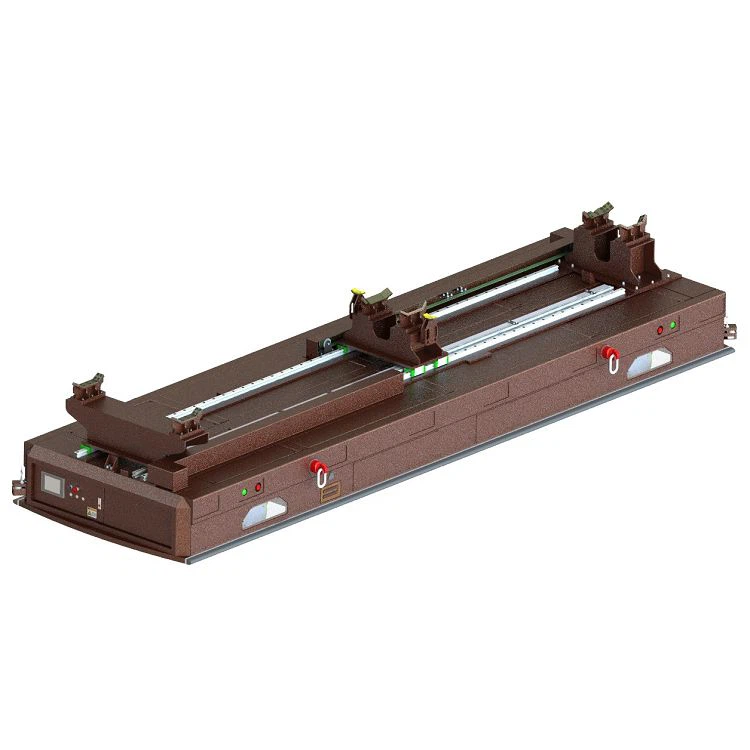
Our Wind Power And Power Generation AGVs are specifically designed to handle these components. They have special loading mechanisms that can secure the blades and nacelles during transportation. The AGV's navigation system is also programmed to take into account the long length of the blades, ensuring that it can navigate through the port without hitting any obstacles.
Large Shipping Containers
Large shipping containers are another common type of oversized cargo in ports. These containers can be difficult to move due to their size and weight. Our AGVs are equipped with powerful lifting mechanisms that can pick up and transport these containers with ease.
The AGV's loading platform is designed to fit the standard dimensions of shipping containers, and it can be adjusted to handle non - standard sizes as well. The precise navigation system ensures that the AGV can place the container accurately at its destination, whether it's on a ship or in a storage area.
Integration with Port Operations
Our Port Transport AGVs are not standalone vehicles. They are designed to integrate seamlessly with other port operations. This includes communication with other vehicles, equipment, and the port's management system.
Communication with Other Vehicles
Our AGVs use wireless communication technologies to communicate with other vehicles in the port. This allows them to coordinate their movements and avoid collisions. For example, if an AGV is transporting oversized cargo and needs to cross a busy intersection, it can communicate with other vehicles to ensure that they stop and let it pass safely.
Integration with Port Management Systems
Our AGVs can also be integrated with the port's management system. This allows the port operators to monitor the movement of the AGVs in real - time, assign tasks, and optimize the overall port operations. For instance, the management system can analyze the traffic flow in the port and assign the most efficient routes to the AGVs based on the current conditions.
Safety Features
Safety is our top priority when it comes to transporting oversized cargo. Our AGVs are equipped with a range of safety features to protect the cargo, the AGV itself, and the port workers.
Collision Avoidance Systems
The AGVs are fitted with collision avoidance systems that use sensors to detect obstacles in their path. If an obstacle is detected, the AGV will automatically stop or change its course to avoid a collision. This is especially important when transporting oversized cargo, as a collision could cause significant damage to the cargo and the port infrastructure.
Emergency Stop Buttons
In addition to the collision avoidance systems, our AGVs are also equipped with emergency stop buttons. These buttons can be pressed by port workers in case of an emergency. When the button is pressed, the AGV will immediately stop moving, ensuring the safety of everyone in the vicinity.
Applications in Different Port Areas
Our Port Transport AGVs can be used in various areas of the port, including the quay, the storage yard, and the Factory Area Transfer.
Quay Operations
At the quay, our AGVs are used to transfer oversized cargo between the ship and the port. They can pick up the cargo from the ship's hold and transport it to the storage area or directly to a waiting truck. The precise navigation and heavy - duty design of our AGVs make them ideal for these operations.
Storage Yard
In the storage yard, our AGVs are used to move oversized cargo to and from storage locations. They can stack and retrieve the cargo efficiently, making the most of the available space in the yard.
Factory Area Transfer
When it comes to transferring oversized cargo between different factory areas within the port, our AGVs are the perfect solution. They can transport the cargo safely and quickly, ensuring that the production process runs smoothly.
Conclusion
In conclusion, our Port Transport AGVs are a reliable and efficient solution for transporting oversized cargo in ports. With their heavy - duty design, precise navigation, customizable loading platforms, and advanced safety features, they can handle the unique challenges of moving these massive loads.
If you're in the port industry and are looking for a solution to transport oversized cargo, we'd love to talk to you. Our team of experts can help you choose the right AGV for your specific needs and provide you with all the support you need to integrate the AGVs into your port operations. Contact us today to start a conversation about how we can improve your port's efficiency and safety when it comes to handling oversized cargo.
References
- Port Automation Handbook: A Guide to Technologies and Applications in Ports.
- Research papers on Automated Guided Vehicles in Port Operations.


