


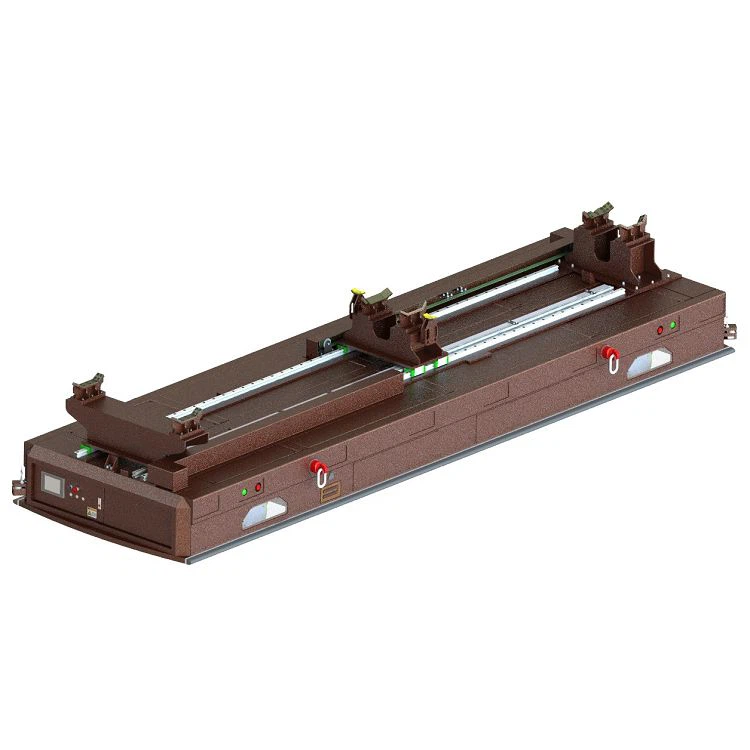
Wind Power And Power Generation AGVs
Tianjin Lonyu Robot : Your Trustworthy Port Transport AGVs Supplier!
Our company is a heavy-duty AGV company with the business philosophy of focus, professionalism, pragmatism and development. Langyu has been committed to professional R&D and production in the field of heavy-duty AGV and smart factory smart logistics. We have more than 50 patents (9 invention patents) and specialize in providing customers with heavy-duty intelligent logistics management systems supported by intelligent logistics technology, industrial Internet of Things, big data center and other technologies to solve the problem of intelligent transportation materials for large goods.
Products Widely Used
The products produced by our company can be widely used in the production, assembly, transportation and production of large workpieces (over-length, over-weight) in aviation, aerospace, military industry, high-speed rail, wind power, metallurgy, engineering machinery, ships, ports, airports, heavy industry and other industries. store.
Innovating
Our company has more than 50 patents, including 9 invention patents. Secondly, we have 131 independent core patents. And most of the products have passed CE, REACH, SGS, FCC and other certifications.
Customizable
Our team has 15 years of professional R&D and production experience in the field of smart logistics and can meet the needs of different markets and customers.
Wide Range of Cooperative Merchants
Since its establishment, our company has cooperated with well-known companies around the world, such as Tesla, Siemens, FAW Toyota, Jinfeng Technology, CAT, JLG and other well-known companies.
Related Product Introduction

Wind Turbine Transport Mover AGV
Wind turbine transport mover AGV (Automated Guided Vehicle) is a self-driving vehicle that is designed for moving wind turbine components such as tower sections, blades, and nacelles from one location to another within a manufacturing facility or to the site for installation. These AGVs are equipped with sensors, cameras, and other navigational technologies that allow them to move precisely and safely, without any human intervention. They are also capable of navigating through complex environments, avoiding obstacles, and adjusting their speed and direction based on the load they are carrying. Wind turbine transport mover AGVs help reduce the risk of injury to workers, increase productivity, and ensure timely delivery of wind turbine components.

Container Transporter AGVs (Automated Guided Vehicles) are self-driving vehicles used to transport shipping containers within a logistics or warehouse environment. These vehicles are equipped with sensors, cameras, and mapping capabilities to navigate the facility and transport containers from one location to another. They are designed to optimize transportation processes, increase efficiency, and reduce labor costs by eliminating the need for human operators to move the containers manually. Container Transporter AGVs can be programmed to follow specific paths, avoid collisions, and operate 24/7 for continuous operation.

Container transport vehicle is designed to use advanced sensors and computer control systems to autonomously transport containers to their destinations. These vehicles have the potential to increase the efficiency and safety of cargo transportation and reduce labor costs.

40ft 20ft Container Trans Flat Car
A 40ft 20ft Container Trans Flat Car is a type of railway freight car that is designed to transport shipping containers that are 40ft or 20ft in length. The flat car has no sides or roof, allowing for easy loading and unloading of containers with a crane. These flat cars typically have four or six wheels and are used in intermodal transportation systems to move containers between ports, rail yards, and highways.

Outdoor Heavy Load GPS AGVs are autonomous guided vehicles equipped with GPS technology that can navigate outdoor environments. They are designed to carry heavy loads and transport them from one location to another without the need for human intervention. These AGVs are typically used in manufacturing facilities, warehouses, and distribution centers where there is a need to move heavy items from one place to another quickly and efficiently. The GPS technology allows the AGVs to accurately navigate outdoor environments, including changes in terrain and obstacles. This type of AGV is often used for tasks such as moving large pallets, crates, and containers.

Outdoor Heavy Duty Navigation AGV
Outdoor Heavy Duty Navigation AGV is a mobile robot designed to transport heavy loads of material from one location to another in an outdoor environment. It is equipped with specialized sensors, such as GPS, LIDAR, and RADAR, to accurately navigate through different terrains, weather conditions and avoid obstacles. The AGV is programmed to follow a predetermined path and can be controlled remotely by an operator or managed automatically by a central control system. The heavy-duty construction of the AGV allows it to handle large and bulky loads, making it ideal for various applications such as logistics, mining, agriculture, and construction industries.

Logistics in the Park AGVs (Automated Guided Vehicles) refer to the use of computer-controlled and self-guided vehicles to optimize logistical operations in a distribution or warehouse facility. AGVs can perform tasks such as transporting goods, picking and placing, and sorting items in warehouses or manufacturing facilities. They are designed to increase efficiency and reduce human error, making them an important part of modern logistics operations. Logistics in the Park AGVs can be used in various industries such as automotive, pharmaceutical, and e-commerce.

Factory Area Transfer refers to an automated guided vehicle system (AGVS) that transports materials or goods between different areas in a factory, such as from the warehouse to the production line or from the production line to the shipping area. This system typically consists of a fleet of vehicles equipped with sensors and control systems that enable them to safely and efficiently navigate through the factory floor and interact with other machines or equipment. The purpose of using Factory Area Transfer AGVS is to improve material handling efficiency, reduce labor costs, and enhance safety in the factory environment.
Port Transport AGVs (Automated Guided Vehicles) are robotic vehicles designed to move containers and other cargo within a port terminal. They are programmed to navigate autonomously along a predetermined path, using sensors to avoid obstacles and follow designated routes. Port Transport AGVs can transfer cargo between ships and terminals, as well as between different areas within the port, increasing efficiency and reducing manual labor requirements. They are also equipped with safety features such as collision avoidance systems to prevent accidents and ensure cargo is delivered securely.
Features of Port Transport AGVs

Carrying Capacity
One of the main advantages of Port Transport AGVs are their ability to move large and heavy loads. These vehicles typically have a carrying capacity of thousands of kilograms, which means they can transport containers, pallets, and other heavy goods with ease.
Real Time Tracking
Another key feature of Port Transport AGVs are the ability to provide real-time tracking information. This means the location of vehicles and their cargo can be monitored at all times, helping to improve safety and enable more effective port management.


Avoid Collision
Port Transport AGVs are equipped with sensors that can detect obstacles and other vehicles on their path. This means they can avoid collisions even in crowded environments.
Various Control Options
Port Transport AGVs can be controlled in a variety of ways, depending on the specific requirements of the port. They can be operated remotely or programmed to follow specific routes and perform certain tasks automatically.

Types of Port Transport AGVs
Container Handling AGV
Container handling is a critical operation in port facilities and AGVs are widely used for this purpose. Container handling AGVs are designed to move containers from one place to another within the port area. These AGVs are equipped with special lifting mechanisms that enable them to efficiently lift and transport loaded or empty containers of various sizes. AGVs are programmed to move containers between different locations such as docks, yards, stacking areas and truck loading areas.
Pallet Transport AGV
Pallet handling AGVs are designed to move palletized goods within port facilities from warehouses to loading and unloading areas. These AGVs are equipped with a pallet handling system that enables them to pick up and transport pallets of different sizes and shapes. Pallet shipping AGVs can operate in a variety of environmental conditions and can be programmed to pick up and transport specific types of goods.
Bulk Material Handling AGV
Bulk Material Handling AGVs are designed to handle bulk materials such as grains, powders and liquids that need to be stored or transported within port areas. These AGVs are equipped with bulk material handling systems that can handle large quantities of materials. Bulk material handling AGVs can be programmed to move materials between locations such as silos, storage tanks and processing facilities.
Trailer AGV
The Tugger AGV has been developed for hauling trailers and trolleys within port areas. These AGVs are designed to transport large quantities of goods between different locations. The Tugger AGV's ability to tow multiple trailers simultaneously makes it an efficient option for moving cargo between warehouses and yards or docks.
Parts of Port Transport AGVs
Carrier Part
The carrier part is the core part of Port Transport AGVs and the most important part. It generally consists of chassis, drive, battery, sensor and control system. With these components, Port Transport AGVs are able to drive autonomously, carry weight and perform logistics transportation from one location to another.
Identify Part
The identification part helps Port Transport AGVs identify target items or objects to avoid collisions during transportation. Currently, commonly used recognition technologies include lidar and cameras. They help Port Transport AGVs recognize surrounding scenery, road signs and obstacles, ensuring that they can drive accurately and stably.
Controller Part
The controller part is the intelligent control system of Port Transport AGVs, which helps the AGV perform various operations. It can also collect and process AGV real-time sensor data to achieve algorithm optimization and decision-making automation. The controller part can be integrated with the enterprise's ERP system or other software to realize logistics automation and optimization.
Energy Part
The energy section is the heart of Port Transport AGVs, combining energy storage and motor converters. Many Port Transport AGVs use lithium-ion batteries as energy reserves because these batteries can provide sufficient energy and have a long life. In terms of power supply, the AGV system is required to be able to flexibly match the needs of the power supply system, including conduction, power exchange or charging.
Understand the Types and Application Scenarios Of AGV
First of all, you need to understand what types of AGVs there are and what scenarios they are used in. Choose the type and function that meets your needs based on actual needs.
Measure the Environment and Distance Required By AGV
The laser navigation technology of AGV requires placing some optical reference points, reflective rods, reflective strips, etc. in the environment, and measuring the distance between the environment size and the AGV according to the on-site conditions, so as to ensure that the AGV can accurately find its way in actual operations.
Understand the Load Capacity of AGV
Different types of AGVs have different load capacities. The load capacity that meets the new actual needs should be selected according to actual needs to avoid failing to meet the demand after investment. If you need to move heavy items or items of different sizes, you need to choose AGVs with lifters.
View the AGV's Operating Path and Path Planning Software
Similarly, in practical applications, it is necessary to observe the actual operating path of the AGV and whether the path can be planned according to needs in order to improve the working efficiency of the AGV.
Vehicle Operation Convenience
The control of AGV is very simple, so it is very important to choose an AGV that is very easy to interact with.
More Options
In addition to the above necessary standards, the AGV's cruising range, AGV's energy consumption, and the pressure on vehicle use caused by increased costs can also be considered. In addition, the option of remote control of the AGV should also be considered to gain more control methods.
Choose the Right AGV For the Job
There are many types of AGVs used for port transportation, including straddle carriers, shuttles, and terminal tractors. Each type has different capabilities and limitations, so it's important to choose the right type for the job. For example, if you need to move containers quickly over short distances, a shuttle carrier may be the best choice.
Plan AGV Routes Carefully
Once you decide on the type of AGV to use, you need to plan its route through the port. This will involve identifying the start and end points, as well as any potential obstacles such as other vehicles or pedestrians. You should also consider the layout of the port and the location of key facilities, such as yards and shipping terminals.
Train Operators To Use AGV Safely
It is important to train operators on how to use AGVs safely and effectively. This may include familiarizing them with the vehicle's controls and teaching them how to navigate through ports. Operators should also be able to recognize potential hazards and know how to respond to emergencies.
Monitor AGV Performance and Maintenance
AGVs require regular maintenance to keep them running smoothly. This may involve checking tires, brakes and other components for wear, as well as cleaning the vehicle and performing routine inspections. You should also monitor your vehicle's performance to identify any issues or areas for improvement.
Integrate AGV Into the Entire Port Operation
AGVs should be considered part of the larger port operations system. This means integrating them with other technologies such as GPS tracking and warehouse management systems to increase overall efficiency and reduce costs. It also involves coordinating with other departments such as logistics and transportation to ensure AGVs are used effectively.
Applications of Port Transport AGVs
Container Handling
Container handling is one of the main applications of AGVs in port transportation. They can be used to move containers from one location to another within the port premises. Port transportation AGVs are programmable machines that can be specifically designed and programmed to handle containers of different sizes and weights. They can transport containers from terminals to storage areas and vice versa.
Transport
Transshipment is the process of moving containers from one ship to another. Port transportation AGVs are designed specifically for transshipment operations. They can safely and accurately transfer containers from one ship to another, regardless of ship size.
Certificate


Frequently Asked Questions
Q: What are Port Transport AGVs?
Q: What benefits do Port Transport AGVs offer?
Q: How do Port Transport AGVs improve port terminal efficiency?
Q: What types of cargo can Port Transport AGVs handle?
Q: How much weight can Port Transport AGVs carry?
Q: How do Port Transport AGVs navigate around the port terminal?
Q: Do Port Transport AGVs require drivers?
Q: What safety features do Port Transport AGVs have?
Q: How are Port Transport AGVs powered?
Q: What is the lifespan of Port Transport AGVs?
Q: Do Port Transport AGVs require regular maintenance?
Q: Are Port Transport AGVs environmentally friendly?
Q: How much does it cost to purchase Port Transport AGVs?
Q: What is the lead time for purchasing Port Transport AGVs?
Q: How easy is it to integrate Port Transport AGVs into existing port infrastructure?
Q: What training is required for port terminal staff to operate Port Transport AGVs?
Q: How do Port Transport AGVs affect job roles at the port terminal?
Q: Can Port Transport AGVs handle hazardous cargo?
Q: What is the level of support provided by the manufacturer of Port Transport AGVs?
Q: Are Port Transport AGVs suitable for use in harsh weather conditions?
Hot Tags: wind power and power generation agvs, China wind power and power generation agvs manufacturers, suppliers, factory, unmanned outdoor forklift vehicles, outdoor unmanned plowing vehicles, outdoor unmanned excavator vehicles, unmanned outdoor sensor deployment vehicles, autonomous guided vehicles for outdoor forestry work, autonomous guided vehicles for outdoor security patrol
Previous
No InformationYou Might Also Like


Send Inquiry