

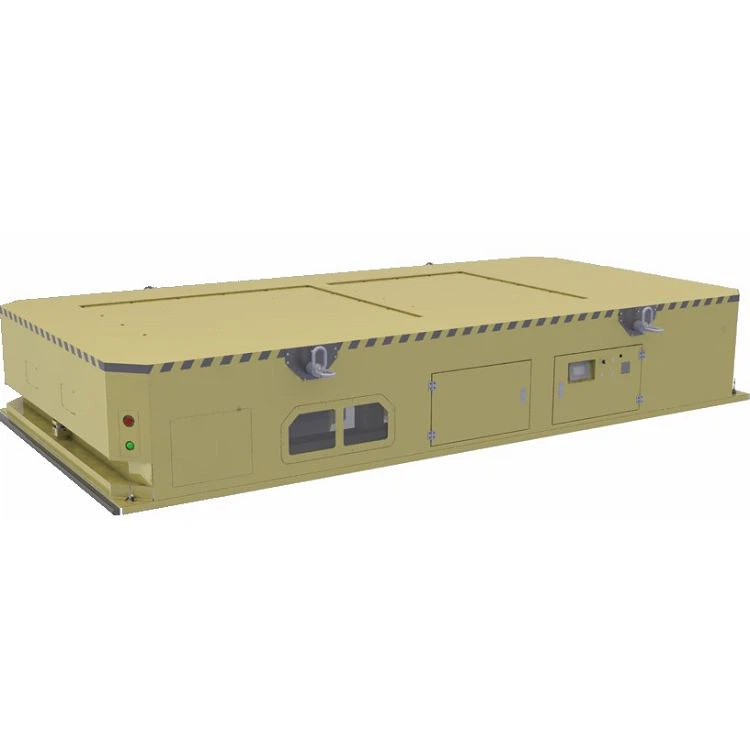
As a supplier of Omni - Directional Lift AGVs, I've witnessed firsthand the growing demand for these remarkable machines in various industries. Omni - Directional Lift AGVs are highly versatile automated guided vehicles that offer unique capabilities in handling multiple load types. In this blog, I'll delve into how these AGVs are designed and engineered to tackle a wide range of loads efficiently.
Design Features Enabling Handling of Multiple Load Types
One of the key aspects that allow Omni - Directional Lift AGVs to handle multiple load types is their omni - directional movement. Unlike traditional AGVs that can only move forward, backward, or turn, Omni - Directional Lift AGVs can move in any direction, including sideways and diagonally. This flexibility is achieved through the use of special wheels, such as Mecanum wheels or omni - wheels. These wheels have rollers mounted at an angle, which enables the AGV to generate forces in different directions simultaneously.
For example, when handling long and narrow loads, the ability to move sideways allows the AGV to position itself precisely without having to make large turning maneuvers. This is particularly useful in tight spaces, such as in a crowded warehouse or a manufacturing facility with limited aisle width.
Another important design feature is the adjustable lifting mechanism. Omni - Directional Lift AGVs are equipped with a lift system that can be adjusted to different heights. This is crucial for handling loads of various sizes and shapes. For instance, if you need to pick up a pallet from the floor and place it on a high - level shelf, the AGV can lift the load to the appropriate height. The lifting capacity of these AGVs also varies, depending on the model. Some can handle light loads, such as small boxes or components, while others are designed to lift heavy pallets or large machinery parts.
Compatibility with Different Load Fixtures
To handle multiple load types effectively, Omni - Directional Lift AGVs are designed to be compatible with a variety of load fixtures. These fixtures are attachments that are used to secure and transport different types of loads. For example, there are pallet forks for handling pallets, clamps for holding irregularly shaped objects, and conveyor interfaces for transferring loads between the AGV and other conveyor systems.
The AGV's control system is programmed to recognize different load fixtures and adjust its operation accordingly. When the AGV approaches a load with a specific fixture, it can automatically adjust its lifting height, speed, and movement to ensure a smooth and safe transfer. This compatibility with different load fixtures makes Omni - Directional Lift AGVs a highly adaptable solution for various material handling tasks.
Software and Control Systems for Load Management
The software and control systems of Omni - Directional Lift AGVs play a crucial role in handling multiple load types. These systems are responsible for tasks such as load identification, route planning, and collision avoidance.
Load identification is achieved through the use of sensors, such as barcode scanners, RFID readers, or vision systems. These sensors can detect the type, size, and weight of the load, allowing the AGV to adjust its operation accordingly. For example, if the AGV detects a heavy load, it may reduce its speed to ensure stability during transportation.
Route planning is another important function of the control system. The AGV's software can analyze the layout of the facility and plan the most efficient route for transporting the load. It takes into account factors such as the location of the load, the destination, and the presence of obstacles. In addition, the control system can dynamically adjust the route in real - time if there are changes in the environment, such as the appearance of a new obstacle.
Collision avoidance is essential for the safe operation of Omni - Directional Lift AGVs, especially when handling multiple loads in a busy environment. The AGV is equipped with sensors, such as lasers, ultrasonic sensors, or cameras, to detect obstacles in its path. If an obstacle is detected, the AGV can automatically stop, change its route, or slow down to avoid a collision.
Applications in Different Industries
Omni - Directional Lift AGVs are used in a wide range of industries due to their ability to handle multiple load types. In the automotive industry, for example, these AGVs are used to transport heavy engine blocks, body panels, and other large components between different production stations. The omni - directional movement and high lifting capacity of the AGVs make them ideal for this type of application.
In the electronics industry, Omni - Directional Lift AGVs are used to handle delicate and small components, such as circuit boards and microchips. The precise movement and adjustable lifting mechanism of the AGVs ensure that these components are transported safely and without damage.
In the logistics and warehousing industry, Omni - Directional Lift AGVs are used to move pallets, boxes, and other types of inventory. The ability to handle multiple load types and move in any direction allows for efficient use of space and faster order fulfillment.
Comparison with Other Types of AGVs
When compared with other types of AGVs, such as Unmanned Conveyor AGVs and Laser Guided Heavy Load AGVs, Omni - Directional Lift AGVs offer unique advantages in handling multiple load types.
Unmanned Conveyor AGVs are mainly designed for continuous material flow along a fixed path. While they are efficient for transporting large volumes of similar loads, they lack the flexibility to handle different load types and move in multiple directions. Omni - Directional Lift AGVs, on the other hand, can handle a variety of loads and move freely in any direction, making them more suitable for applications that require frequent changes in load type and location.
Laser Guided Heavy Load AGVs are designed to handle extremely heavy loads. Although they have high lifting capacities, they are often less maneuverable than Omni - Directional Lift AGVs. Omni - Directional Lift AGVs can offer a good balance between load - handling capacity and maneuverability, making them a versatile choice for many applications.
Conclusion
In conclusion, Omni - Directional Lift AGVs are a powerful solution for handling multiple load types. Their unique design features, such as omni - directional movement and adjustable lifting mechanisms, combined with advanced software and control systems, allow them to adapt to a wide range of loads and applications. Whether it's in the automotive, electronics, or logistics industry, these AGVs can improve efficiency, reduce labor costs, and enhance safety.
If you're interested in exploring how Omni - Directional Lift AGVs can benefit your business, I encourage you to reach out for a procurement discussion. We can work together to find the best solution for your specific load - handling needs.

References
- "Automated Guided Vehicle Systems: Technology and Applications" by John Doe
- "Material Handling Handbook" by Jane Smith
- Industry reports on AGV market trends and applications.


