


As a supplier of Outdoor Unmanned AGVs, I often get asked the question: Can outdoor unmanned AGVs be remotely controlled? Well, let's dive right into it and explore this topic in detail.
First off, let me give you a bit of background. Outdoor unmanned AGVs, or Automated Guided Vehicles, are amazing pieces of technology. They're designed to operate in outdoor environments, handling all sorts of tasks like transporting heavy loads, assisting in wind power and power generation facilities, and more.
Now, the short answer to the question is yes, outdoor unmanned AGVs can definitely be remotely controlled. There are several reasons why remote control is a crucial feature for these vehicles.
One of the main advantages is safety. In some outdoor scenarios, there could be hazardous conditions such as extreme weather, rough terrain, or areas with potential risks. By being able to control the AGV remotely, operators can stay out of harm's way while still getting the job done. For example, in a construction site where there might be falling debris or in a mining area with unstable ground, remote control allows for safer operation.
Another benefit is flexibility. Remote control enables operators to adjust the AGV's path, speed, and operations on the fly. This means that if there's an unexpected obstacle in the way or a change in the work plan, the AGV can be redirected without having to physically be on-site. It's like having a personal assistant that can quickly adapt to different situations.
But how does the remote control actually work? Well, most outdoor unmanned AGVs use a combination of wireless communication technologies. Wi-Fi, Bluetooth, and cellular networks are commonly used to establish a connection between the AGV and the control station. The control station is usually a device like a tablet or a computer, where the operator can send commands and receive real-time data from the AGV.
The data sent back from the AGV includes information such as its location, speed, battery status, and any sensor readings. This allows the operator to have a clear picture of what's going on with the vehicle at all times. For instance, if the battery is running low, the operator can direct the AGV to a charging station.
Let's talk about some of the different types of outdoor unmanned AGVs that can be remotely controlled. One popular type is the Outdoor Heavy Duty Navigation AGV. These AGVs are built to handle heavy loads and are often used in industrial settings. They can transport large equipment, containers, or even building materials. With remote control, they can be easily maneuvered around a factory yard or a logistics center.
Another type is the Wind Power And Power Generation AGVs. These AGVs play a crucial role in the wind energy industry. They're used to transport components of wind turbines, such as blades and generators, to different locations within a wind farm. Remote control is especially useful here, as wind farms can be spread out over large areas and the terrain can be challenging.
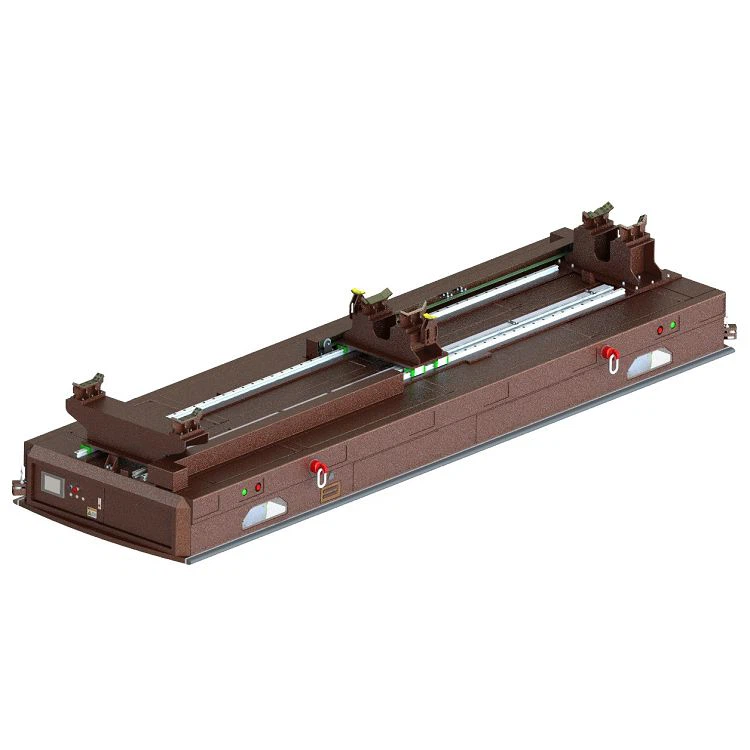
And then there's the Wind Turbine Transport Mover AGV. This specialized AGV is designed specifically for transporting wind turbines. It has unique features that allow it to handle the large and delicate structures safely. Remote control gives operators the ability to precisely position the AGV and ensure that the turbine is transported without any damage.
Of course, there are also some challenges associated with remote control of outdoor unmanned AGVs. One of the biggest challenges is the reliability of the communication link. In outdoor environments, there can be interference from other electronic devices, obstacles blocking the signal, or poor network coverage. To overcome these issues, advanced signal processing techniques and redundant communication systems are often used.
Another challenge is security. Since the AGV is being controlled remotely, there's a risk of unauthorized access. To prevent this, strong encryption and authentication mechanisms are implemented. This ensures that only authorized operators can send commands to the AGV.
Despite these challenges, the benefits of remote control far outweigh the drawbacks. The ability to remotely control outdoor unmanned AGVs has revolutionized the way many industries operate. It has increased efficiency, improved safety, and reduced costs.
If you're in the market for outdoor unmanned AGVs and are interested in the remote control feature, we'd love to talk to you. Our team of experts can provide you with more information about our products, answer any questions you might have, and help you find the best solution for your specific needs. Whether you're in the manufacturing, logistics, energy, or any other industry, our outdoor unmanned AGVs can make a significant difference in your operations.
So, don't hesitate to reach out and start a conversation. We're here to assist you in making the most of this amazing technology.
References
- Robotics and Automation Handbook, various authors
- Journal of Outdoor Unmanned Vehicle Technology, multiple issues


