

I'm a supplier of Laser Guided Heavy Load AGVs, and today I wanna talk about a crucial topic: what's the minimum operating space required for these awesome machines?
First off, let's get a basic understanding of Laser Guided Heavy Load AGVs. These babies are pretty high - tech. They use laser technology to navigate around a workspace, carrying some seriously heavy loads. They're like the muscle cars of the industrial automation world, but instead of burning rubber, they burn up the efficiency levels in warehouses, factories, and other large - scale industrial environments. You can learn more about them here.
Now, when it comes to figuring out the minimum operating space, there are quite a few factors that come into play.
1. Size of the AGV
The physical dimensions of the Laser Guided Heavy Load AGV itself are a major starting point. These AGVs can vary a lot in size, depending on their load - carrying capacity. For instance, if you're dealing with an AGV that's designed to carry a really heavy load, like up to 50 tons, it's gonna be a lot bulkier compared to one that can only carry 5 tons. And obviously, the bigger the AGV, the more space it needs to move around.
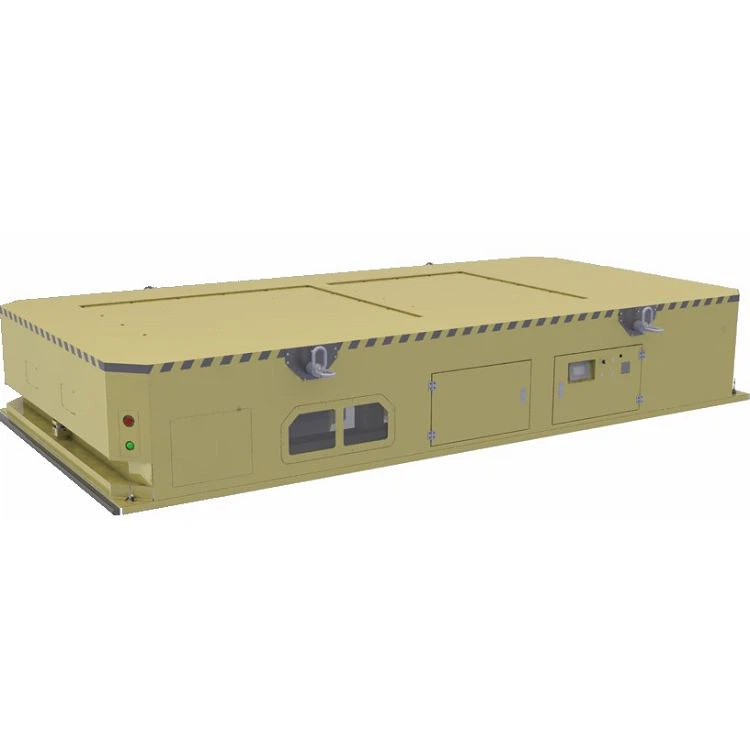

Let's say you have a standard - sized Laser Guided Heavy Load AGV with a length of about 4 meters, a width of 2 meters, and a turning radius of 3 meters. Just for it to make a simple turn without hitting anything, it needs a space that's at least as large as its turning radius allows. So, about a 6 - 7 - meter diameter circular area would be needed for a basic turning movement.
2. Load Dimensions
The load that the AGV is carrying can also have a huge impact on the space requirements. If the load is long and wide, it can significantly increase the overall footprint of the AGV - load combination. Imagine an AGV carrying a large, rectangular piece of machinery. The extra length and width of that load mean the AGV needs more clearance on all sides to maneuver safely.
For example, if the AGV itself is 2 meters wide, but it's carrying a load that adds another half - meter to each side, suddenly it's effectively 3 meters wide. This means the aisles and turning areas in the operating space need to be at least wide enough to accommodate this wider profile.
3. Navigation and Turning Radius
The way the AGV navigates is directly related to the space it needs. Laser - guided AGVs are pretty precise, but they still need a certain amount of room to make turns and change directions. Some AGVs have a relatively small turning radius, which is great as it allows them to operate in tighter spaces. Others, though, especially those with heavier loads or certain types of wheel configurations, may have a larger turning radius.
If an AGV has a large turning radius, it needs a lot of open space to make a U - turn or a 90 - degree turn. In a factory setting, this could mean that the layout of the work area needs to be carefully planned to ensure there are large enough turning bays. And if the AGV has to operate in a narrow aisle, special navigation algorithms may be needed to help it make the most of the limited space.
4. Safety Clearances
Safety is super important when it comes to operating AGVs. There always needs to be some extra space around the AGV to prevent collisions with other equipment, walls, or people. This safety clearance can vary depending on the environment. In a high - traffic area with lots of human workers, you might need a larger safety clearance, say 1 - 2 meters on all sides of the AGV.
In a more automated, restricted area where there are fewer potential obstacles, the safety clearance could be reduced to maybe 0.5 meters. But even a small safety clearance adds up when you're calculating the total operating space.
5. Traffic Flow
If you have multiple AGVs operating in the same area, traffic flow becomes a big deal. You need to make sure that the AGVs can pass each other without getting stuck or causing a traffic jam. This means having wide enough aisles and well - defined traffic lanes.
For example, if you have two AGVs that are each 2 meters wide and you want a 1 - meter safety clearance between them when they pass, the aisle needs to be at least 5 meters wide. And you also need to consider how the AGVs are going to enter and exit different areas of the workspace. There should be enough space for them to queue up if necessary and to merge into the main traffic flow smoothly.
Real - World Scenarios
Let's look at a couple of real - world scenarios to see how these factors play out.
Warehouse Scenario
In a warehouse, you might have a series of storage racks and a network of aisles. If you're using Laser Guided Heavy Load AGVs to move pallets of goods, you need to make sure the aisles are wide enough. Let's assume the AGV is 1.8 meters wide, and it's carrying a pallet that adds 0.2 meters to each side, making the total width 2.2 meters. You also want a 0.5 - meter safety clearance on each side. So, the aisle should be at least 3.2 meters wide.
For turning areas at the end of the aisles, you need to consider the AGV's turning radius. If the turning radius is 2.5 meters, you need an area of at least 5 - 6 meters in diameter to allow the AGV to make a smooth turn.
Factory Assembly Line Scenario
In a factory assembly line, the AGVs are used to move heavy components between different workstations. Here, the space requirements are often very specific. The AGV needs to be able to position itself precisely at each workstation. There might be limited space for it to approach and back out of these stations.
Let's say the AGV has to move a large engine block to a specific assembly point. The approach area needs to be wide enough to accommodate the AGV and the load, plus a small safety clearance. And there should be enough room for the AGV to make any necessary adjustments to its position before dropping off the load.
Comparing with Other Types of AGVs
It's also interesting to compare the space requirements of Laser Guided Heavy Load AGVs with other types of AGVs. For example, Unmanned Conveyor AGVs are often designed to operate in a more linear fashion, moving goods along a conveyor - like path. They usually have a smaller turning radius and may require less space for overall operation compared to heavy - load AGVs.
On the other hand, All Direction Heavy Load AGVs are more flexible in terms of movement. They can move in all directions, which means they can potentially operate in smaller spaces. However, they still need enough space to handle their heavy loads and to ensure safety.
Conclusion
Figuring out the minimum operating space for Laser Guided Heavy Load AGVs is a complex task. It involves taking into account the size of the AGV, the dimensions of the load, the navigation requirements, safety clearances, and traffic flow. Each industrial environment is different, and a careful analysis of these factors is necessary to design an efficient and safe operating space.
If you're in the market for Laser Guided Heavy Load AGVs and need help determining the right operating space for your specific needs, or if you have any other questions about our products, don't hesitate to reach out. We're here to assist you in making the best decision for your business.
References
- Industrial Automation Handbook, 3rd Edition
- AGV Design and Operation Guidelines, published by the Industrial Automation Association


