


Lifting Heavy Load AGVs
Tianjin Lonyu Robot : Your Trustworthy Fully Automatic Heavy-duty AGV Supplier!
Our company is a heavy-duty AGV company with the business philosophy of focus, professionalism, pragmatism and development. Langyu has been committed to professional R&D and production in the field of heavy-duty AGV and smart factory smart logistics. We have more than 50 patents (9 invention patents) and specialize in providing customers with heavy-duty intelligent logistics management systems supported by intelligent logistics technology, industrial Internet of Things, big data center and other technologies to solve the problem of intelligent transportation materials for large goods.
Products Widely Used
The products produced by our company can be widely used in the production, assembly, transportation and production of large workpieces (over-length, over-weight) in aviation, aerospace, military industry, high-speed rail, wind power, metallurgy, engineering machinery, ships, ports, airports, heavy industry and other industries. store.
Innovating
Our company has more than 50 patents, including 9 invention patents. Secondly, we have 131 independent core patents. And most of the products have passed CE, REACH, SGS, FCC and other certifications.
Customizable
Our team has 15 years of professional R&D and production experience in the field of smart logistics and can meet the needs of different markets and customers.
Wide Range of Cooperative Merchants
Since its establishment, our company has cooperated with well-known companies around the world, such as Tesla, Siemens, FAW Toyota, Jinfeng Technology, CAT, JLG and other well-known companies.
Related Product Introduction

Overweight Parts Trans AGVs (Automated Guided Vehicles) refer to autonomous vehicles that are specifically designed to transport and maneuver overweight and bulky parts within a manufacturing plant, warehouse, or logistics center. These AGVs are equipped with advanced sensors and navigation systems that enable them to navigate through complex environments, avoid obstacles, and ensure the safety of the transported goods. They are widely used in automotive, aerospace, and heavy equipment industries to transport large parts such as engines, gearboxes, and chassis. The use of these AGVs reduces manual labor, improves productivity, and enhances the efficiency of material handling processes.

Backpack heavy-load AGV is an automated guided vehicle that carries heavy loads on its back like a backpack. Its load capacity can reach up to 1000kg or more, which makes it suitable for transporting heavy materials or equipment in warehouses or factories. The vehicle is equipped with sensors and a computerized control system that guides it along predefined paths without the need for a human operator. It can also be programmed to perform various tasks like picking up and dropping off materials, loading and unloading trucks, and moving products from one location to another in a production line. The backpack heavy-load AGV increases efficiency and accuracy in material handling processes while reducing the risk of injury to human operators.

Huge Material AGVs (Automated Guided Vehicles) refer to large, autonomous vehicles used for material handling and transportation in industries such as logistics, manufacturing, and warehousing. These AGVs are designed to move heavy loads, typically weighing several tons, and are equipped with advanced navigation and control systems that allow them to operate safely and efficiently in complex environments. Huge Material AGVs can be used for a wide range of applications, including pallet transportation, container handling, and bulk material transfer.

Heavy Duty Omni Direction AGVs
Heavy Duty Omni Direction AGVs (Automated Guided Vehicles) are autonomous vehicles designed to move heavy loads and materials around manufacturing plants, warehouses, and other industrial settings. These AGVs use omnidirectional wheels to move in any direction and can handle larger loads than traditional AGVs. They are equipped with sensors and software that allow them to navigate around obstacles and avoid collisions, while following predetermined paths to deliver goods and materials to their designated locations. Heavy Duty Omni Direction AGVs can improve efficiency, reduce costs, and increase safety in industrial settings.

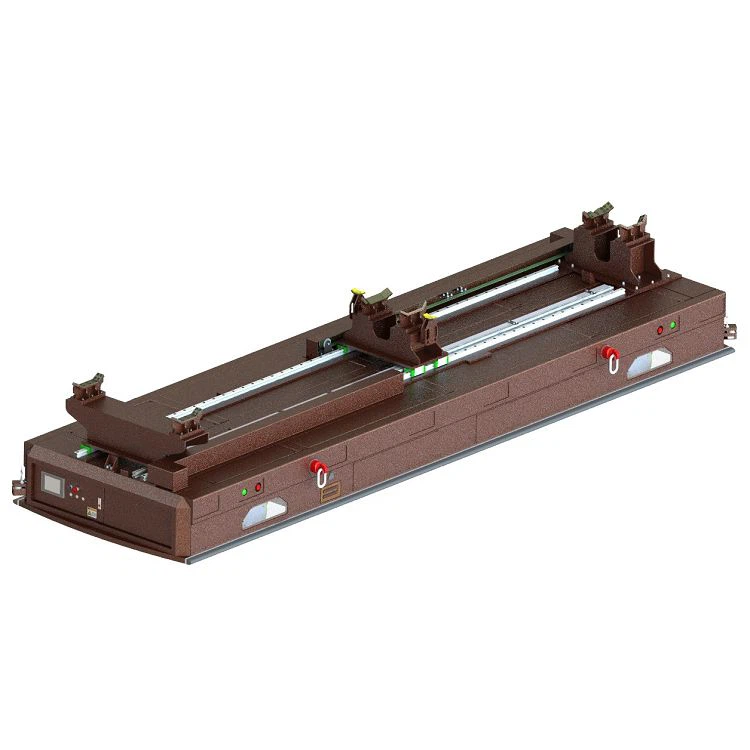
Lifting Heavy Load AGVs (Automated Guided Vehicles) are specialized robotic vehicles designed for lifting and transporting large and heavy loads. They are often used in manufacturing and logistics environments where heavy loads need to be lifted and moved safely and efficiently. These AGVs are equipped with heavy-duty lifting mechanisms that allow them to handle loads that would be too heavy for human operators. They can be programmed to move to specific locations, pick up loads, transport them to their destination and drop them off automatically. Lifting Heavy Load AGVs are becoming increasingly popular in industries where safety, efficiency, and cost-effectiveness are key priorities.

Wind Genset Transport AGVs refer to Autonomous Guided Vehicles (AGVs) specifically designed to transport components used in the construction and maintenance of wind turbines, such as generators (gensets). These AGVs use automated navigation systems to move between locations without human intervention, reducing the need for manual labor and improving efficiency in the transportation process. They are typically equipped with sensors and cameras that enable them to avoid obstacles and navigate safely in complex environments. Wind Genset Transport AGVs are becoming increasingly popular in the renewable energy industry due to their ability to streamline operations and reduce costs.

Heavy Duty Navigation AGVs are autonomous guided vehicles that are designed to carry heavy loads and operate in demanding industrial environments. These AGVs are typically equipped with advanced navigation technologies such as lidar, cameras, and sensors that allow them to safely navigate in complex environments. They are used in industries such as automotive, aerospace, and logistics to move large and heavy components or materials around a factory or warehouse. Heavy Duty Navigation AGVs are known for their durability and reliability, as they are built to withstand harsh working conditions.

Super Heavy Transport AGVs (Automated Guided Vehicles) are specialized industrial robots designed for moving extremely heavy loads over long distances within a factory or warehouse environment. These AGVs are capable of carrying loads weighing several tons and are usually equipped with sophisticated sensors, cameras, and software algorithms to navigate autonomously in complex environments. Super Heavy Transport AGVs can be used for a wide range of applications, such as transporting raw materials, finished products, or heavy machinery components, among others. They can operate 24/7 and are designed for optimal efficiency, safety, and productivity.
A Fully Automatic Heavy-duty AGV (Automated Guided Vehicle) is an industrial mobile robot that is designed to move heavy loads or materials within a factory or warehouse environment without human intervention. These AGVs are equipped with advanced sensors, cameras, and mapping technology that enables them to navigate around obstacles and recognize designated routes. They have the ability to transport large and heavy loads ranging from several hundred kilograms to several tons while ensuring the safety of other equipment, workers, and goods in the area. These vehicles are fully electric and rechargeable with high-capacity batteries, which ensures a long working time for continuous operations.
Features of Fully Automatic Heavy-duty AGV
Heavy Load Capacity
The fully automatic heavy-duty AGV is specially designed to handle heavy loads and is equipped with a powerful lifting mechanism. They can handle loads of up to 50 tonnes, making them ideal for industries such as automotive, aerospace and logistics.
Flexible Integration
AGVs can easily integrate with existing systems and equipment to seamlessly automate the material handling process. Vehicles can communicate with other machines and equipment in the facility, allowing material flows to be updated and adjusted in real time.
High Precision Control
The fully automatic heavy-duty AGV has an advanced control system that enables precise movement and positioning. The vehicle can be programmed to move with sub-millimeter precision, ensuring material is transferred exactly where it is needed.
Improve Security
AGVs are designed with safety in mind and are equipped with a range of safety sensors and systems. The vehicle can detect obstacles, people and other hazards in the environment and can adjust speed or come to a complete stop to avoid collisions and accidents.
Types of Fully Automatic Heavy-duty AGV
Unit Load AGV
Unit load AGVs are used to transport pallets, containers and other large unit loads on factory or warehouse floors. Unit load AGVs are typically equipped with rollers or chain conveyors to move loads to and from the vehicle. They can also be equipped with sensors to detect obstacles and avoid collisions.
Traction AGV
Towed AGVs are another type of fully automated, heavy-duty AGVs. They are used to transport trailers or dollies that do not fit into typical pallet handling systems. Tow AGVs are equipped with a tow bar and hitch system that allows them to tow loads behind them. These vehicles are typically used in automobile assembly plants to transport automobile engines or other large components.

Forklift AGV
Forklift AGVs are designed to replace traditional forklifts in factories and warehouses. These vehicles are capable of lifting and transporting large loads and can be equipped with different types of forks to handle different types of loads. Forklift AGVs can also be programmed to perform different types of lifting operations, such as side shifting or tilting.
Assembly Line AGV
Assembly line AGVs are used in manufacturing plants to transport materials and products to and from production lines. These vehicles are often equipped with specific sensors and tools that enable them to perform specialized tasks such as machine maintenance, product assembly and material handling.

How to Choose Fully Automatic Heavy-duty AGV
Important Load Capacity and Working Environment
First, you need to know the maximum load capacity of the AGV you need. The average peak weight of materials transported by workers at one time is about 2200 pounds/1000 kilograms, so the maximum load capacity should be 3 to 5 times the hourly cargo transportation volume. At the same time, you also need to consider the working environment, especially the limitations of the floor, lifts, and shelf areas.
Map Fonts and Accuracy
The most important point of the AGV navigation system is to establish accurate maps and map fonts. A good AGV must build accurate maps that can avoid errors and jams. Similarly, the map font must be accurate to ensure the accuracy of AGV execution tasks and reduce unnecessary pauses and stops, which waste time and resources.
System Availability and Compatibility
Fully automatic heavy-duty AGVs must have high availability to ensure system durability and long-term stable operation. Secondly, it should also be compatible with all major system RPC protocols (similar to AFSC) since this is the regional standard for building systems. And once a failure or problem occurs, there must be complete support services and dynamic adjustment of strategies.
Data and Analytics
For fully automated heavy-duty AGVs, data collection and analysis can improve overall efficiency by reducing costs and increasing productivity. This functionality must always be available and must be scalable to meet future needs.
Safety
One of the important factors for AGVs is safety. Safety features include an emergency stop button, anti-collision measures, and an audible/visual warning system. Additionally, it should be able to meet regulatory standards in various regions.
How to Maintain Fully Automatic Heavy-duty AGV

Periodic Inspection
Preventive Maintenance
Use Correctly
Training
Upgrades and Repairs
Applications of Fully Automatic Heavy-duty AGV
Logistics Industry
Fully automated heavy-duty AGVs can transport heavy goods such as pallets, crates and packages from one location to another within a warehouse. It can reduce the physical labor required to move these heavy objects and improve the overall efficiency of logistics operations. AGVs can also be used in autonomous pick and place applications where they can pick up pallets from one location and move them to another without human intervention.
Automobile Industry
The automotive industry is another industry that benefits greatly from fully automated heavy-duty AGVs. AGVs are used to transport raw materials such as steel and aluminum to production lines. They can also be used to transport automotive parts such as engines, transmissions and tires from one assembly station to another. Additionally, AGVs can be used in autonomous material handling applications to move finished products from assembly lines to storage locations.
Manufacturing
In the manufacturing industry, fully automatic heavy-duty AGVs can automate material handling operations. They can transport raw materials to production lines and remove finished products from them. AGVs can also be used to transport heavy machinery and equipment to different production locations within a factory. AGVs can increase productivity, reduce labor costs and improve safety on the factory floor.
Renewable Energy Industry
The renewable energy industry also benefits from fully automated heavy-duty AGVs. AGVs can be used to transport heavy solar panels, wind turbines and other equipment to construction sites. They can also be used to transport materials such as steel and concrete to the site. AGVs can help speed up the construction process, reduce labor costs and improve safety.
Certificate


Frequently Asked Questions
Q: What is a Fully Automatic Heavy-duty AGV?
Q: How does a Fully Automatic Heavy-duty AGV work?
Q: What are the advantages of using a Fully Automatic Heavy-duty AGV in a manufacturing facility?
Q: What are the different types of Fully Automatic Heavy-duty AGVs?
Q: How much weight can a Fully Automatic Heavy-duty AGV carry?
Q: What is the maximum speed that a Fully Automatic Heavy-duty AGV can travel?
Q: Can a Fully Automatic Heavy-duty AGV be programmed to perform different tasks?
Q: What is the lifespan of a Fully Automatic Heavy-duty AGV?
Q: How reliable are Fully Automatic Heavy-duty AGVs?
Q: Can a Fully Automatic Heavy-duty AGV be customized to specific needs?
Q: What is the maintenance cost of a Fully Automatic Heavy-duty AGV?
Q: What safety measures are in place to ensure the safety of workers around Fully Automatic Heavy-duty AGVs?
Q: What are the different industries that use Fully Automatic Heavy-duty AGVs?
Q: How does a Fully Automatic Heavy-duty AGV impact production efficiency and cost savings?
Q: Can a Fully Automatic Heavy-duty AGV work alongside human workers?
Q: How long does it take to integrate a Fully Automatic Heavy-duty AGV into a manufacturing facility?
Q: Is training required to operate a Fully Automatic Heavy-duty AGV?
Q: What are some of the future developments expected in Fully Automatic Heavy-duty AGV technology?
Q: How does a Fully Automatic Heavy-duty AGV navigate through a manufacturing facility?
Q: What is the price range for a Fully Automatic Heavy-duty AGV?
Hot Tags: lifting heavy load agvs, China lifting heavy load agvs manufacturers, suppliers, factory, heavy load agv with advanced technology, heavy duty automated guided vehicle, heavy load agv for cluster storage, heavy load agv for hierarchical storage, heavy load agv for pallet picking as rs, heavy load agv for electric vehicle production
Previous
Overweight Parts Trans AGVsYou Might Also Like


Send Inquiry